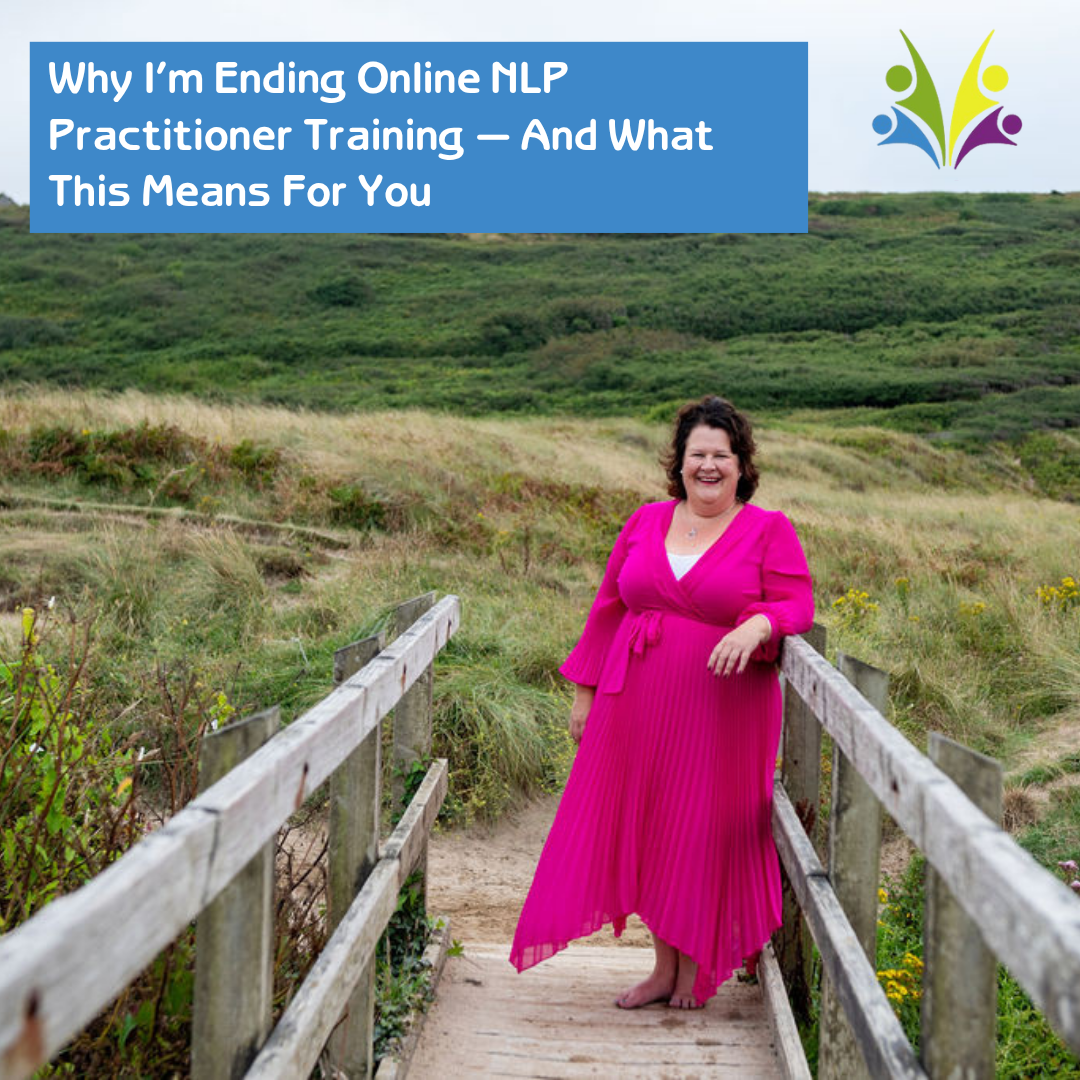
Why I'm Ending Online NLP Practitioner Training - and what it means to you
After almost 13 years in NLP training, I’m making a decision that feels significant — and I want to be completely upfront about it.
From the end of autumn 2026, Unleash Your Potential will no longer offer the Level 1 NLP Practitioner or Level 2 Certified NLP Coach programmes online. The cohort running this autumn will be the last ever online NLP Practitioner and NLP Coach programme I deliver.
I want to be clear about something before I say anything else: this is not a marketing stunt. This is not a scarcity tactic designed to make you panic-book. This is a genuine, personal decision — and you deserve to know exactly why I’ve made it.
Where Online Training Came From
When I first started training NLP in 2014, everything was in person. That’s all there was (if you wanted quality training). I loved it, and I was good at it — but after COVID the world had been forced online, people had adapted and saw the benefits of learning online and we saw demand for online trianing increase. After much thought and deliberation, I had to adapt, and I did.
In September 2022 (if my memory serves me correctly), I launched the online NLP Practitioner programme. Honestly? I threw myself into it completely, not knowing quite how it would work. And it worked brilliantly. The formula I developed is solid. Students are getting incredible results. The flexibility has opened our quality of NLP training to people all over the world — students I would never otherwise have reached, from Australia, the USA, Egypt, the Philippines, and beyond.
I’m genuinely proud of that.
But here’s the truth: my heart has always been in the room.
What I’m Going Back To
There’s something that happens in a live training room that I’ve never quite managed to replicate on Zoom — not for want of trying. It’s the conversation over a cup of tea before we start. It’s watching two strangers arrive on day one and leave as proper friends. It’s the dinner in the evening where someone shares something they’ve been carrying for years and the whole group holds space for them. It’s the informal moments — the walk on the beach, the unexpected laugh — where, often, the real magic happens.
That's why after my move to Cornwall in Feb 2025, I reflected on what brought me joy and it's my passion for nature, being by the sea, for time outdoors, helping people and quality trianing. That's why I started #NLPByTheSea in Cornwall this year, and the first group in May was a blast - great people, great training and great time outdoors sharing what I love. And it has become something I’m genuinely, deeply proud of.
The training at Falmouth isn’t just NLP — it’s a full experience. I passionately believe that coaches, leaders, and therapists often fail to look after themselves. They spend their lives helping others but neglect their own wellbeing in the process. So alongside the training, I include breathwork sessions, cold water dipping with a qualified instructor, forest bathing, Qi Qong and social events. One delegate who had never had the confidence to enter the sea now does cold water dipping regularly at home. Another learned breathwork during the course and told me she practices it every single day. That’s not just NLP training. That’s life-changing.
I want to put my full focus there. And that means something has to give.
What This Means If You Were Considering Training Online
If you’ve been on the fence — if online training has been on your radar and you haven’t quite got around to it — I’d encourage you to read this carefully, because the window is closing.
The final ever online NLP Practitioner runs 16–18 October and 6–9 November 2026. The final ever online Certified NLP Coach runs 27–30 November 2026.
These really are the last ones.
Here’s what you get:
- Live training with me — every session, no exceptions. I personally deliver every course I run.
- Dual accredited training (ABNLP & ANLP) — I’m not aware of any other dual-accredited online NLP Practitioner at this price point in the UK right now, delivered with the sea as your playground at lunchtime!
- Only 8 spaces left — I keep groups small deliberately, and when these spots are gone, they’re gone.
- Open globally — wherever you are in the world, this is the most cost-effective way to train with me. All you need is WiFi and access to Zoom.
- Flexible structure — self-paced pre-course study that you complete at a time to suit you, then two focused weekends of live training with me.
Jacob Reid trained with us online and he's put it better than I can:
“Laura and her training have genuinely changed my life. It’s more than the training. Although stellar, it’s the level of support I was offered throughout that stood out more than anything else… My mindset and the results I’ve experienced have changed completely, and I am empowered to go on and now help others develop along their own journeys.”
LIMITED TIME: SPECIAL OFFER
We want this last online course to be a great one. So to help make the decision that bit easier, if you book by the 28th September 2026 we are offering a 20% discount.
These programmes consistently change the trajectory of people’s careers and lives.
Amy Lawther completed her Practitioner and Coach online with me and said:
“What a life changing experience! I joined the course to support my business, little did I know the impact this would have on both my business and my personal life. I genuinely believe this course has elevated my life and me as an individual.”
What About After Autumn?
In-person NLP training with me continues — and now with my full focus. The Cornwall courses will remain exactly what they are: warm, immersive, genuinely transformational, with all the #NLPByTheSea experience that makes them special.
If the autumn online dates genuinely don’t work for you, there may be a limited option in some cases to do part of the online programme this autumn and then join the January Cornwall course via Zoom for certain sessions. This is something I consider on a case-by-case basis — so if that’s your situation, get in touch and we’ll have an honest conversation about whether it could work.
A Note of Genuine Gratitude
To everyone who has trained with me online over the past few years — thank you. You took a leap of faith on something new, and you made it everything I hoped it could be.
Sara Brown said of her online experience: “I cannot express how the practitioner then coach course has changed so much of my life professionally and personally. If you are looking to take steps to being the best version of yourself and to help others, this is your first and will be your best step.”
That means the world to me. Truly.
Aysha Amin, who trained with me online, described it as:
“One of the most incredible experiences. I have learned so much about how the mind works, how we hold onto patterns without realising, and how to shift them powerfully. It’s given me tools I can use in my own life and in my business and I’m already seeing the difference.”
That’s what this training is. And that’s what I’m honoured to offer — one last time, online.
What Now?
Get in touch if you'd like to find out more about the last online NLP Practitioner & Coach courses, or if you'd like to find out more about the January NLP By The Sea Trainings:
email: info@unleashyourpotential.org.uk
I hope to see your name on the list
Laura x