Resilience – do you have what it takes?
In the current climate our ability to sail through challenging and changing times has never been so key. Resilience, the ability to ‘bounce back’ to ‘roll with the punches’ and respond to change is the difference between those businesses and career professionals that thrive and those that just survive.
Last week I delivered a keynote session for Accountants at the ACCA National Wales conference title: “Building Resilience: Future Proof your Skills with a Winning Mindset”. My message was clear: in the current climate of Trump, Covid, Brexit et al – technical skills, talent and experience will not be enough – it’s our ability to become more resilient that will set us apart from others …. our mindset, the way we choose to view change and challenge is key … our ability to get out there, seize opportunities, adapt, take risks and keep getting back up will be critical …. the only constant will be change – do you have what it takes?
What is Resilience?
‘Resilience is a person’s capacity to respond to pressure … resilient people are better able to deal with constantly changing priorities …’
‘Resilience is the ability to withstand, adapt to and recover from difficult situations’
‘one of the main characteristics of organisations which succeed where others fail directly relate to how resilient their Leaders and People are’
The Resilient Mindset is key
What makes resilient people recover so fast and cope with change so easily? What impact does this have on their organisation? their Career? their success?
Resilience is about how people approach life and everything that is thrown at us – resilience is not a 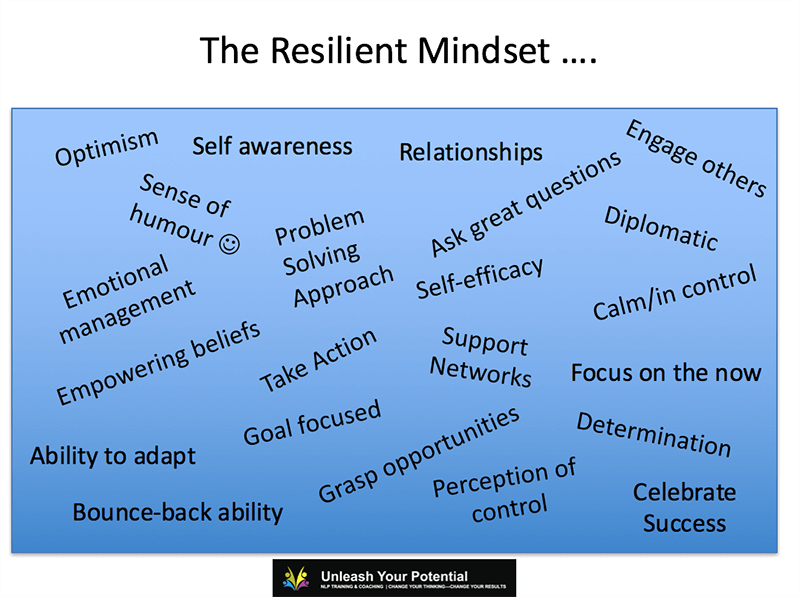 characteristic gifted to some people and not others – the key to resilience is it’s an active process. One of the main characteristics of organisations that succeed where others fail directly relates to how resilient the leaders and people within it are. Of course, sleep, exercise, eating healthily all play their part in resilience, but in my experience mindset (our approach) is just as, if not more important.
Given our mindset is so key to resilience, it stands to reason that Neuro-Linguistic Programming (NLP) can offer us insights and ways in which we can build our personal resilience. You will most likely be aware you have a conscious and unconscious mind (if not check out this blog). The unconscious mind is the domain of the emotions and resilient people are ’emotionally focused’ – in that they are great at managing emotions. Resilient people proactively manage their emotions (perhaps through humour, relation, mindfulness), they tend not to deny a problem or bury their head in the sand, nor take knee jerk reactions. NLP offers us many ways in which we can become better at managing our emotions.
1. Empowerment: NLP Theme
We teach the 4 themes of NLP on our NLP Business Diploma and NLP Practitioner courses. The first one is Empowerment. In life, you will find people at either the ‘effect’ or ’cause’ side of the cause/effect equation. People that at the ‘effect’ side are people full of reasons ‘why not’, excuses and often talk as if they are at the effect side of something or someone else (they blame the economy of their failing business, they blame how their parents brought them up etc etc). On the other hand, people at ’cause’ take responsibility, have an attitude of resourcefulness, empower themselves, think ‘there has to be a way’, they take decisions and more.
Take for example someone being made redundant – there are two ways to view your situation – you can either sit back and blame everyone else for what’s happened, give reasons why not etc (effect side) or you can take responsibility and make some decisions about your future. I was made redundant 3 times and each time I applied for ReAct funding, gained some qualifications and got even better jobs! The difference is mindset.
2. NLP Reframing
How great are the questions you ask yourself? – many of us spend lots of time asking ourselves pretty rubbish questions and then wondering why the answers don’t get us where we want to go! Resilient people find ‘usefulness’ in any situation and are great at asking great questions and managing their internal dialogue. Seeing an opportunity for them is key, they ask themselves questions such as:
- ‘What else could this mean?’
- ‘How could this situation be useful and what could I do to take advantage of the challenges?’
- ‘Given the resources I’ve got now, what can I plan for and what’s the best response I’ve got to the situation I’m in now?’
All these questions help us to ‘reframe’ the situation. To position it in a more resourceful, useful way.
3. Are your Beliefs empowering?
Over the years I’m going to guess you’ve picked up a number of limiting beliefs – beliefs that you hold about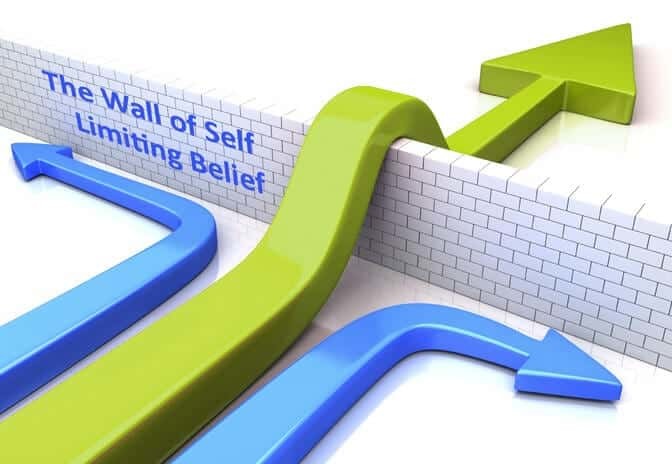 yourself that disempower you or hold you back in some way. Examples of limiting beliefs could include I can’t do ‘x’, I’m not good enough etc. Consider how great your results would be is your starting point was ‘I can’t survive Brexit, my business is doomed to fail’ – ok, maybe you don’t have a belief like that, but you know the types of beliefs I’m talking about … What are the stories you’re telling yourself? Are they empowering you or limiting you?
We are only limited by our current thinking
Resilient people have positive beliefs about their own ability, about optimising, self-belief, commitment and more. On our NLP Practitioner courses we teach people how to take a limiting belief and turn it into an empowering belief in around 20 minutes – just imagine what a difference that makes to someone’s results!
What to learn more about NLP?
… then come and join us on one of our public courses (or our online training) and we’ll gladly share more with you about how you can acquire the NLP mindset for success. Perhaps you’d like to join us on our next 2 day NLP Diploma (click here for dates of the next course) – a great introductory course, no prior experience required and directly relevant to those in organisations.
Perhaps you want to come on our the 7 day NLP Practitioner course – a certified course, accredited by the ABNLP (governing body) which will provide you with the ultimate personal development course and equips you to use NLP to help others. Our next NLP Practitioner course dates can be found by clicking here.
Both these course get fully booked, so act quickly to secure your place!
If you’d like to find out more about any of our courses, contact us at: info@unleashyourpotential.org.uk or call us on 02920 023311 and Lyn would be happy to help answer any of your questions.